Back to Top
  • Essential Balance Massage and Wellness.

    Lorem ipsum dolor sit amet, test link adipiscing elit.Nullam dignissim convallis est.Quisque aliquam.

    Read More

  • Come experience the secrets of relaxation

    Lorem ipsum dolor sit amet, test link adipiscing elit.Nullam dignissim convallis est.Quisque aliquam.

    Read More

  • Relaxation. No longer beyond your budget

    Lorem ipsum dolor sit amet, test link adipiscing elit.Nullam dignissim convallis est.Quisque aliquam.

    Read More

What is Python? (Kiran Computer Classes)


What is Python?

Python is a high-level, general-purpose, interpreted object-oriented programming language. Similar to PERL, Python is a programming language popular among experienced C++ and Java programmers.

Working in Python, users can interpret statements in several operating systems, including UNIX-based systems, Mac OS, MS-DOS, OS/2 and various versions of Microsoft Windows 10 and Windows 11.


Python's origins and benefits

Python emerged three decades ago. Its inventor, Dutch programmer, Guido van Rossum, named it after his favorite comedy group at the time, Monty Python's Flying Circus. Since then,

it has attracted a vibrant community of enthusiasts who work on fixing potential bugs and extending capabilities of the code.

Python is known for being powerful, fast and for making programming more fun. Python coders can dynamically type variables without having to explain what the variable is supposed to be. Users can download Python at no cost and start learning to code with it right away. The source code is freely available and open for modification and reuse.

Python adoption is widespread because of its clear syntax and readability. Used often in data analytics, machine learning (ML) and web development, Python yields code that is easy to read, understand and learn. Python's indentation requirements for source statements help make the code consistent and easy to readApplications developed with Python code tend to be smaller than software built with programming languages like Java. Programmers generally have to type less code.

KCC RATANPUR

Python programming also remains popular because the interpreter is excellent at discovering bugs and raising an exception. In this case, bad inputs never trigger a segmentation fault. As the debugger is Python-based, users won't have to worry about any potential conflicts.

Python continues to grow and is actively used by some of the largest multinationals and corporations that also support Python with guides, tutorials and resources.
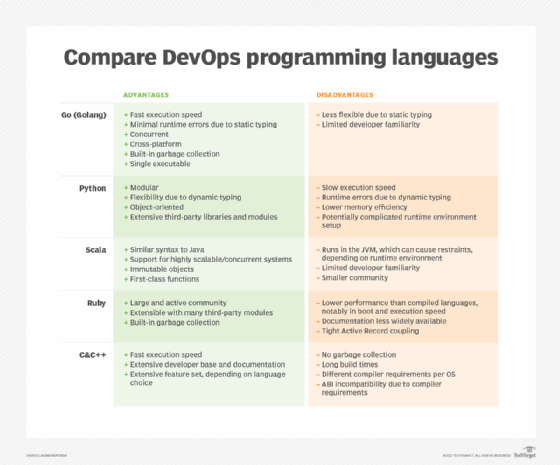
compare devops programming languages
See above to explore how Python's advantages and disadvantages compare to those of other languages.

Python use cases

Python offers dynamic data types, ready-made classes and interfaces to many system calls and libraries. Users can also extend it using another programming language like C or C++. Its high-level data structures, dynamic binding and dynamic typing make it one of the go-to programming languages for rapid application development.

Python also is often used as a glue or scripting language that seamlessly connects existing components. Users can use it for scripting in Microsoft's Active Server Page technology.

Primary use cases for Python include the following:

  • ML
  • server-side web development
  • software development
  • system scripting

Anyone who uses Facebook, Google, Instagram, Reddit, Spotify or YouTube has encountered Python code. Python code can also be found in the scoreboard system for the Melbourne (Australia) Cricket Ground. Z Object Publishing Environment, a popular web Application Server, is written in Python.
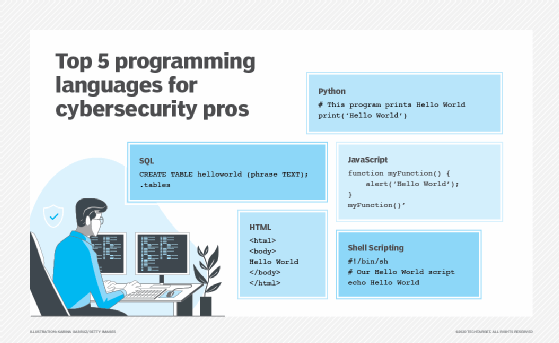
top programming languages for cybersecurity professionals Source: Chart Library
Python code is the basis of many common cybersecurity tools.

Python training and tools

As a result of extensive community support and a syntax that stresses readability, Python is relatively easy to learn. Some online courses offer to teach users Python programming in six weeks.

Python itself also provides modules and packages to learn and supports program modularity and code reuse. As users work with Python, they will want to be familiar with the current version, development environment and supporting tools, specifically the following:

  • Python 3.0, which dates to 2008, remains the latest version. Unlike previous updates that concentrated on debugging earlier versions of Python, Python 3 had forward compatibility and coding style changes. As a result, Python 3 could not support previous releases. The code syntax narrowed in on code repetition and redundancy, allowing the code to tackle the same tasks in many different ways. This single change made it much easier for beginners to learn Python programming.
  • Integrated Development and Learning Environment (IDLE) is the standard Python development environment. It enables access to the Python interactive mode through the Python shell window. Users can also use Python IDLE to create or edit existing Python source files by leveraging the file editor.
  • PythonLauncher lets developers run Python scripts from the desktop. Simply select PythonLauncher as the default application to open any .py script by double-clicking on it through the Finder window. PythonLauncher offers many options to control how users launch Python scripts.
  • Anaconda is a leading open source distribution for Python and R programming languages with over 300 built-in libraries specially developed for ML projects. Its primary objective is to simplify package management and deployment.
  • Python is a highly cost-effective solution when users add the free extensive standard library and Python interpreter into the mix. It is highly versatile. For example, users can quickly engage in edit-test-debugging cycles with no compilation step needed. For these and other reasons, software developers often prefer to code in Python and find that it helps increase their productivity.

What is Java programming language used for? KCC RATANPUR


What is Java?

Java is a widely-used programming language for coding web applications. It has been a popular choice among developers for over two decades, with millions of Java applications in use today. Java is a multi-platform, object-oriented, and network-centric language that can be used as a platform in itself. It is a fast, secure, reliable programming language for coding everything from mobile apps and enterprise software to big data applications and server-side technologies.

What is Java programming language used for?

What is Java programming language used for? 

Because Java is a free-to-use and a versatile language, it builds localized and distributed software. Some common uses of Java include:

1.     Game Development

Many popular mobile, computer, and video games are built in Java. Even modern games that integrate advanced technology like machine learning or virtual reality are built with Java technology.

2.     Cloud computing

Java is often referred to as WORA – Write Once and Run Anywhere, making it perfect for decentralized cloud-based applications. Cloud providers choose Java language to run programs on a wide range of underlying platforms.

3.     Big Data

Java is used for data processing engines that can work with complex data sets and massive amounts of real-time data.

4.     Artificial Intelligence

Java is a powerhouse of machine learning libraries. Its stability and speed make it perfect for artificial intelligence application development like natural language processing and deep learning.

5.     Internet of Things

Java has been used to program sensors and hardware in edge devices that can connect independently to the internet.

Java is popular because it has been designed for ease of use. Some reasons developers continue to choose Java over other programming languages include:

High quality learning resources

Java has been around for a long time, so many learning resources are available for new programmers. Detailed documentation, comprehensive books, and courses support developers through the learning curve. In addition, beginners can start writing code in Core Java before moving to Advanced Java.

Inbuilt functions and libraries

When using Java, developers don’t need to write every new function from scratch. Instead, Java provides a rich ecosystem of in-built functions and libraries to develop a range of applications. 

Active community support

Java has many active users and a community that can support developers when they face coding challenges. The Java platform software is also maintained and updated regularly.

High-quality development tools

Java offers various tools to support automated editing, debugging, testing, deployment, and change management. These tools make Java programming time and cost-efficient.

Platform Independent

Java code can run on any underlying platform like Windows, Linux, iOS, or Android without rewriting. This makes it especially powerful in today’s environment, where we want to run applications on multiple devices.

Security

Users can download untrusted Java code over a network and run it in a secure environment in which it cannot do any harm. Untrusted code cannot infect the host system with a virus nor can it read or write files from the hard drive. The security levels and restrictions in Java are also highly configurable.

How does Java work?

All programming languages are a means to communicate with machines. Machine hardware only responds to electronic communication. High-level programming languages like Java act as a bridge between human language and hardware language. To use Java, a developer needs to understand two things:

1. Java language and APIs

This is the front-end communication between the developer and the Java platform.

2. Java Virtual Machine

This is the back-end communication between the Java platform and the underlying hardware. Let’s look at each of these in detail below.

What is Java API?

Java defines the syntax and semantics of the Java programming language. This includes the basic vocabulary and rules used to write algorithms such as primitive data types, if/else blocks, loops, etc.

APIs are important software components bundled with the Java Platform. These are pre-written Java programs that can plug and play existing functionality into your own code. For example, you could use Java APIs to get the date and time, perform mathematical operations, or manipulate text. 

Any Java application code written by a developer will typically combine new and pre-existing code from Java APIs and Java libraries.

What is Java Virtual Machine?

The Java Virtual Machine acts as an additional abstraction layer between the Java platform and the underlying machine hardware. Java source code can run only on those machines that have JVM installed on them. The answer to why the Java Virtual Machine is needed lies in the history of programming.

The history of programming

When natural programming languages were first developed, they fell into two broad categories, depending on how they communicated with the underlying hardware.

  1. Compilers: The complete program is written in natural English-like syntax with compilers, and the language then compiles (or translates) the entire code into machine code. The compiled code is then run on the hardware.
  2. Interpreters: With interpreters, every high-level code statement is interpreted into machine code on the fly.  Written statements are run immediately by the hardware before looking at the next statement.

The Java runtime environment

The Java program was the first language to combine both methods above using a Java Virtual Machine (JVM). The Java code compiler is called the Java Virtual Machine. Any Java file is first compiled into bytecode. Java bytecode can only run in the JVM. The JVM then interprets the bytecode to run it on the underlying hardware platform. So if the application is running on a Windows machine, the JVM will interpret it for Windows. But if it is running on an open-source platform like Linux, the JVM will interpret it for Linux. 

How to program in Java

To begin programming in Java, you need to install a Java Edition on your system. There are four main Java editions: 

  1. Java Standard Edition (Java SE)
  2. Java Enterprise Edition (Java EE)
  3. Java Micro Edition (Java ME)

What is Java SE?

Java Standard Edition is the core Java programming platform. It contains all of the libraries and APIs that any programmer needs for java development. Open Java Development Kit(OpenJDK) is the free and open source implementation of Java SE.

Amazon Corretto is a no cost, multiplatform, production-ready distribution of OpenJDK. It can be used as a drop-in replacement for many Java SE distributions and comes with no-cost, long term support from Amazon. It lets you run the same environment in the cloud, on premises, and on your local machine.

What is AWS SDK for Java?

AWS SDK for Java simplifies uses of AWS Services by providing a set of libraries that are consistent and familiar for Java developers. It supports higher-level abstractions for simplified development. AWS-focused open-source Java libraries are available along with code examples and a Java API reference guide.

The SDK code examples contain Java code examples and real-world use cases for AWS services to help accelerate the development of your applications. In addition, the Java API reference guide describes the API operations for the latest version of the AWS SDK for Java. The reference guide also provides sample requests, responses, and errors for the supported web services protocols.

Get started with AWS SDK for Java at the developer guide or visit the AWS Java Developer Center.